

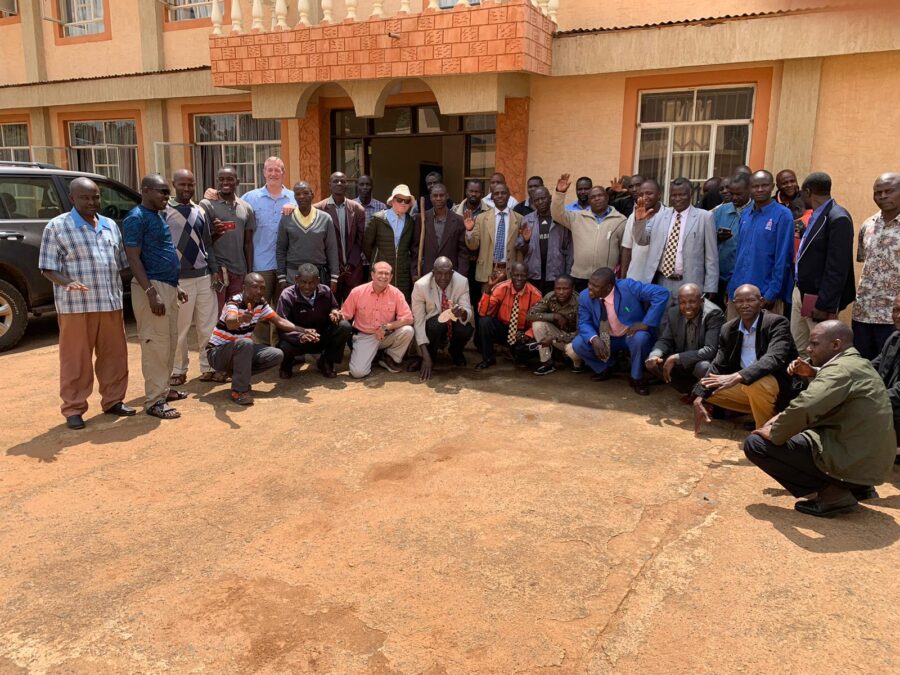
In July 2019, myself and four other Primitive Baptist ministers – Charles Kitchens, Paul Blair, Silas Ford, and Derrick Kitchens – traveled to Kenya to preach and teach the word of God to hungering disciples of Christ. Brother Charles and Paul then continued on an additional leg of the trip to preach and teach in Tanzania for another extra week. This was a very blessed trip, and this is a brief account of our preaching trip.
Category: Articles Page 8 of 13

My heart is fixed, O God, my heart is fixed; I will sing and give praise.” (Psalm 57:7)
King David was on the run as he penned these words. We know from the notation at the beginning of this Psalm that this was penned as David was fleeing from Saul for his life and hiding in a cave. In spite of such a difficult and challenging situation around him in his circumstances, David did not let that calamity get down into his heart. His heart was still fixed firmly upon the Lord, trusting in his mercy and providence.

“In the day of prosperity be joyful, but in the day of adversity consider: God also hath set the one over against the other, to the end that man should find nothing after him.” (Ecclesiastes 7:14)
One hymn we grew up singing in the church begins with this line, “Mixtures of joy and sorrow, I daily do pass through.” That is the reality of being citizens of a heavenly country passing through a foreign land, a world that’s filled with sin and sorrow. It’s inevitable in this life for us to experience great joy in the days of prosperity, but those good days are always tempered and closely followed with the days of adversity, as Solomon had fully experienced in his life. However, the final result of these contrasting highs and lows in the Christian’s life are “to this end” – that “God also that set the one over against the other, to the end that man should find nothing after him”.

“Through the tender mercy of our God; whereby the dayspring from on high hath visited us, To give light to them that sit in darkness and in the shadow of death, to guide our feet into the way of peace.” (Luke 1:78-79)
As Zacharias begins to conclude his prophecy of Christ and then of his son, John the Baptist’s role in the gospel, he introduces Jesus as the “dayspring from on high” come down to visit us. Christ’s first advent was certainly the dawning of a new ray of light for the Jewish community of his day, but in a much more broad sense, Jesus and the light of the good news of the gospel is a light in a dark place for the children of God.
“And when he had removed him, he raised up unto them David to be their king; to whom also he gave testimony, and said, I have found David, the son of Jesse, a man after mine own heart, which shall fulfill all my will.” (Acts 13:22)
In the midst of Paul’s sermon here in Acts 13, he describes the former king of Israel, David, in a very unique way – as a man after God’s own heart. What distinguished King David as a man after God’s own heart? It was his commitment to fulfill all the will of God. It should be our desire as well to be men and women after God’s own heart by submitting to and following the will of God in our lives.

“Then Peter, turning about, seeth the disciple whom Jesus loved following; which also leaned on his breast at supper, and said, Lord, which is he that betrayeth thee?” (John 21:20)
The Apostle John introduces himself in a curious way quite a few times in his gospel, as “the disciple whom Jesus loved”. This might sound, at first blush, as almost a prideful statement by John, declaring himself as the object of Jesus’ love. However, John was not declaring any preeminence over anyone else, that he was the sole or primary source of God’s love. Instead, he simply viewed his primary identity as being loved by Jesus Christ. In like manner, we need to place our primary identity as being loved by Christ.
“And wisdom and knowledge shall be the stability of thy times, and strength of salvation: the fear of the Lord is his treasure.” (Isaiah 33:6)
This world has been in a perpetual state of chaos and turmoil since the sin of Adam cursed this world and all its inhabitants. How then can we have any real “stability” in the midst of a world that is filled with so much calamity, sorrow, pain, and vitriol? God gives us the prescription for that “stability” here in his word: it’s by “wisdom and knowledge” that our times can be stabilized while we briefly sojourn here in this world.

“By faith Abraham, when he was called to go out into a place which he should after receive for an inheritance, obeyed; and he went out, not knowing whither he went.” (Hebrews 11:8)
Abraham is called to a great act of faith in the Lord. He is commanded to leave and begin a journey to a foreign land but is not given the destination by the Lord beforehand. How did Abraham leave and journey with such uncertainty in his walk of discipleship? “By faith Abraham…obeyed, and he went out, not knowing whither he went.” Rarely in life will we fully see the final destination of the Lord’s will at the beginning of that journey. That’s just fine because our responsibility is simply to walk by faith, just like the example of Abraham.

I have spent my last few Sunday morning messages considering different prayers and aspects of prayer. One theme that has really stood out to me throughout those studies and messages is this: one of the chief purposes (if not the main purpose) of prayer is to more fully conform ourselves to submission to the will of God in our lives.
“For he saith to Moses, I will have mercy on whom I will have mercy, and I will have compassion on whom I will have compassion. So then it is not of him that willeth, nor of him that runneth, but of God that sheweth mercy.” (Romans 9:15-16)
In the midst of this chapter declaring God’s sovereignty in election and salvation, we find this profound exaltation of the mercy and compassion of God. Sometimes we get an idea in our minds that we deserve a lot more than we truly do. The truth is that we don’t deserve anything other than the wrath of God, and anything less or better than that is in God’s holy hand to disperse or withhold, according to his own will. When we consider what we truly deserve, that should make us ever more grateful for what we have been freely given by the Lord.