
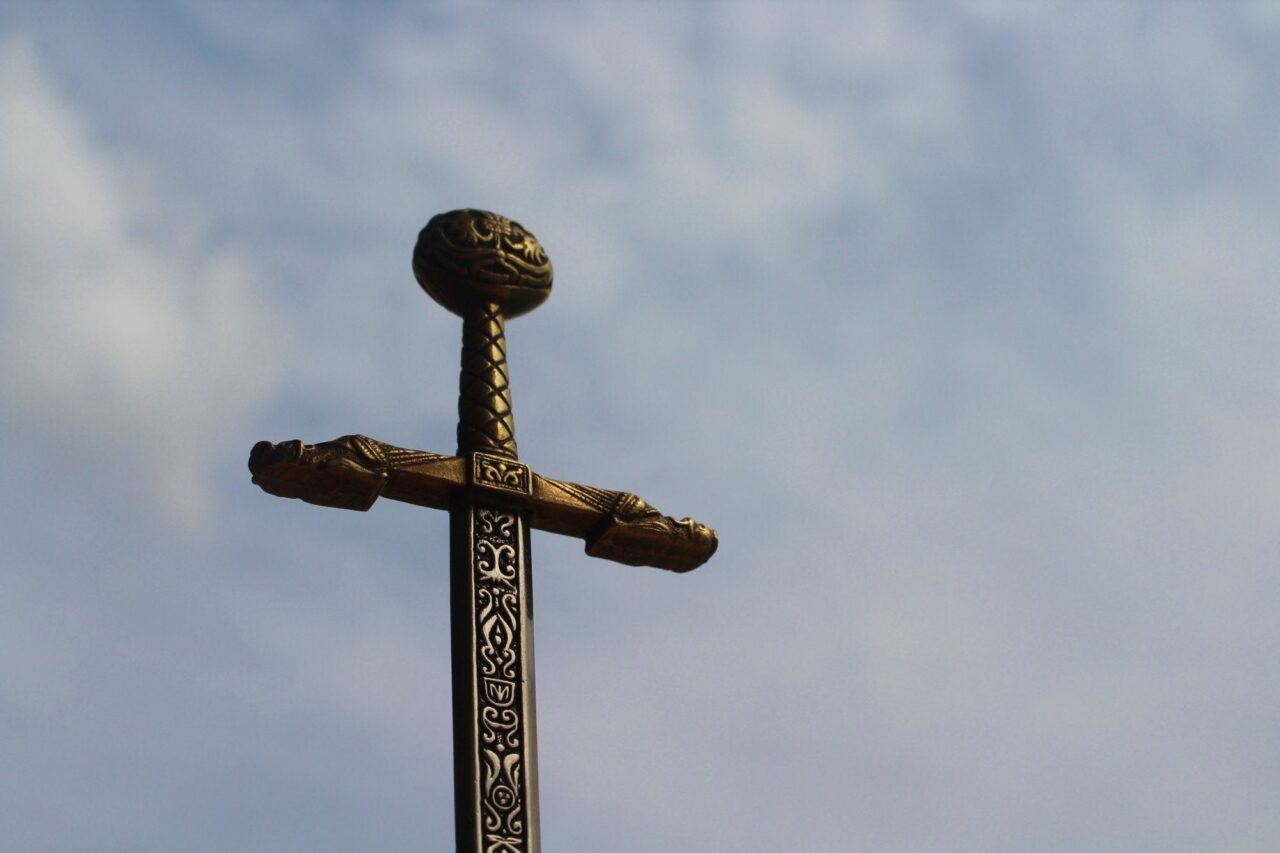
“And the priest said, The sword of Goliath the Philistine, whom thou slewest in the valley of Elah, behold, it is here wrapped in a cloth behind the ephod: if thou wilt take that, take it: for there is no other save that here. And David said, There is none like that; give it me.” (1 Sam. 21:9)
In David’s victory over Goliath, swords are a prominent focal point of the story. When David shows a desire to fight Goliath, Saul offers him his own sword and armor. David does not take Saul’s sword nor armor because he had not proved them (1 Sam. 17:39) but instead relies upon his shepherd’s sling for the battle. Then, when David comes out against Goliath, he publicly declares that the battle is the Lord’s – not fought or won with the weapons of man, such as swords and spears. “45) Then said David to the Philistine, Thou comest to me with a sword, and with a spear, and with a shield: but I come to thee in the name of the LORD of hosts, the God of the armies of Israel, whom thou hast defied… 47) And all this assembly shall know that the LORD saveth not with sword and spear: for the battle is the LORD’S, and he will give you into our hands.” (1 Sam. 17:45-47) When David slew Goliath with just a stone from his sling, scripture makes sure to denote that there was no sword in David’s hand. “So David prevailed over the Philistine with a sling and with a stone, and smote the Philistine, and slew him; but there was no sword in the hand of David.” (17:50)
After Goliath falls to the ground dead, David runs up and takes Goliath’s sword and cuts off his head. “Therefore David ran, and stood upon the Philistine, and took his sword, and drew it out of the sheath thereof, and slew him, and cut off his head therewith. And when the Philistines saw their champion was dead, they fled.” (17:51) We are told that David brought all of Goliath’s armor to his tent, but the sword is not specifically mentioned (17:54). The assumption would be he took Goliath’s sword into his tent as well, but we are not told specifically.
The staff of Goliath’s spear was like a weaver’s beam and his spear’s head weighed 600 shekels of iron (17:7). If the head was probably 15 pounds, the whole spear would have been probably at least 25 pounds. A normal sword in these Bible times would have maybe been a 24 inch blade, so maybe a 30 inch sword, wielded by an average height 6 foot tall man. William Wallace – the Scottish independence hero and inspiration for the Braveheart movie – was known for his large sword. In his day when most swords were no more than 36 inches long, the Wallace Sword – that is still on display in Scotland – has a 52 inch blade and the sword is 64 inches (5 feet, 4 inches) long in full, weighing 6 pounds. The Wallace Sword is clearly much larger than any other sword of that era and stood out to everyone that saw that sword.
If William Wallace was a large man – believed to be 6 ½ feet tall but not a giant by any means – and his sword was 5 ½ feet long, then it would be safe to presume that since Goliath was 9 ½ feet tall and considering the excessive size of his spear that his sword would have been over 6 feet long, maybe even larger. Since David is described as being a ruddy shepherd boy – a smaller or more normal size man, compared to Saul (who would be more like William Wallace) – it’s very possible that Goliath’s sword was literally as large as David was at 6 feet long or more. It’s clear that Goliath’s sword would have been obvious anywhere it went because it was larger than a normal size man, and could not be worn by a normal man in a sheath by your side, but had to be carried with two hands to be obvious everywhere it went.
We don’t hear anything else about Goliath’s sword until 1 Sam. 21:9. From chapters 17-21, David gains in popularity among the people and Saul’s jealousy caused him to turn on David. With the help and counsel of Jonathan, David leaves Judah and goes to Nob to Ahimelech the priest. When David learns that a Saul zealot – Doeg the Edomite – is near and desires to hurt him, he requests what weapons Ahimelech has and he offers David the sword of Goliath. We don’t know how Ahimelech ended up with the sword of Goliath. Due to the sword being as large as David himself, it was not practical to use on a daily basis. It’s very likely David donated it to the priests to serve as a memorial of God’s victory over the Philistines, but we don’t know for sure how the sword made its way from David to Ahimelech.
David flees to Achish, the king of Gath, that same day he got the sword (21:10). Gath was the hometown of Goliath (17:14), and he flees to the land of the Philistines – even to Goliath’s hometown – carrying Goliath’s sword that was as large as him. Goliath’s sword was so large and unique it would have been obvious to everyone in Gath that it was their fallen hero’s sword, putting an even further target on David’s back. Due to being afraid of his enemy, Saul, in Israel, David makes the horrible decision to seek refuge with his own worst enemies, the Philistines. David was truly public enemy number 1 among the Philistines, especially in Gath. Why would David leave his homeland where one man wanted to kill him, to go to the land of his enemies where literally every single person would want to kill him? We cannot take refuge from our problems in the land of our enemies. Even if things are difficult in the homeland, we should always trust God in Zion, and never seek refuge in the land of our enemies. David gets himself into such a bad situation that he had to pretend to be crazy to get out of it (21:10-15). Also note that Psalms 56 & 34 & 52 correspond to this period of time from the subheaders at the beginning of those psalms. Those three psalms are certainly worth reading in this study to understand the setting in which those words were penned.
The sword of Goliath was a reminder to David and all of God’s people that victory over this world comes through the power of God, not by our own personal might. Goliath came to battle trained in the war and killing tactics of man and this world, being a man of war from his youth. He came to battle with the weapons of the world as his trust, primarily his extraordinarily large sword. The seemingly impossible victory of the little ruddy shepherd boy with a sling over the 9 ½ foot tall giant who was a man of war from his youth was proof that the “sword” of victory was God’s sword of power, not man’s sword. We trust in the sword of God’s power over enemies, not our own physical weapons of warfare.
Similar to Gideon, when the Lord took an unlikely man to lead God’s people to great victory, when the 300 men broke their lamps, they cried out “the sword of the Lord and of Gideon” (Judges 7:20). The sword is a picture of God’s strength and victory on behalf on his people, particularly over their enemies, the enemies of righteousness. The sword of victory was the Lord’s, and the sword of Goliath was a reminder of God’s sword, God’s power over our enemies, man’s wisdom, and this world. The sword of Goliath should have been a reminder to David of the courage and boldness we should have in trusting God for his safety and victory over our enemies and over the attacks of the world, despite how perilous things might seem in the moment.
However, when David is once again given the sword of Goliath – given the tangible reminder to trust God’s victory over our enemies, instead of devising the way of the world, or the way of men – what does he do? David makes the absurdly foolish decision to flee to the land of his enemy instead of trusting God to deliver him from the hand of Saul. David should have been able to look at Goliath’s sword that he was carrying that was large as him and see the tangible reminder of God’s victory over his enemies and victory over the tactics of the world, and have his faith renewed that God was going to deliver him out of the hand of Saul. The sword of Goliath should have been a reminder to trust God in his homeland, instead of fleeing for false protection in the land of his sworn enemies where no doubt every single Philistines would love to kill David, especially in Gath.
Instead of touching that sword and his faith being emboldened, he got afraid and ran away. Fear – especially fear of our life – can cause us to make some very poor decisions. In Psalms 56:3, we have one of the most encouraging verses in all of God’s word – “What time I am afraid, I will trust in thee.” However, look at the setting where this verse was delivered – “when the Philistines took him in Gath”. David was afraid of Saul and made a horrible decision to leave his homeland to flee to Gath. Then, his fear got even worse when he was taken because he put himself in a bad position. At any of these times, he should have felt the sword of Goliath and trusted God. However, despite the poetry of David’s psalm, he did not trust God in this situation. He fled to the Philistine land because he didn’t trust God instead of taking up Goliath’s sword to renew his faith in God. He put himself into a horrible position by his own fear and lack of faith, and he faked being crazy to get out of the perilous situation he put himself in. Even after making these bad decisions, he should have took up Goliath’s sword and destroyed the Philistines. It would only be one against multitudes, but those numbers wouldn’t matter if the Lord was going to bless him to destroy his enemies. David was afraid, but he was afraid because of the bad situation he put himself in through his bad decisions. He is the one who put himself in this bad spot by not trusting God to protect him from Saul in his homeland. I know we can all relate to that in some degree. We get into great fear because we’ve made bad decisions that put ourselves in a perilous spot, when all along, we should reach into our spiritual sheath, and pull out the sword of the Spirit and trust God with the shield of faith. By the end of Psalm 56, David’s faith is renewed in trusting God for deliverance of his enemies, but again, he only got out of that by faking being crazy, instead of wielding the sword of Goliath to destroy his enemies.
The sword of Goliath should have been a memorial stone to remind David that victory comes from God, to trust the Lord for protection and victory over our enemies. However, David did not use the sword as the reminder to trust God in faith as he ought to. In 1 Sam. 7:12, after an earlier victory over the Philistines, Samuel set up a specific Ebenezer stone for all to see as a perpetual reminder to all of God’s people to trust God as our help. “Then Samuel took a stone, and set it between Mizpeh and Shen, and called the name of it Ebenezer, saying, Hitherto hath the Lord helped us.” Ebenezer means “a stone of help”. God is our Stone of help. You may recognize this word from the hymn, Come Thou Fount: “Here I raise my Ebenezer, hither by thy help I’ve come…” Samuel gathered and stacked stones to memorialize the time and place God delivered Israel from the Philistines. It served as a memorial to remind Israel how Samuel prayed and made sacrifice to God in a time of great peril, and God answered his prayer and saved Israel from destruction.
After the miraculous crossing of the Jordan River, the Lord commanded Joshua to set up 12 memorial stones in the midst of the river, to serve as a public reminder to all of God’s people of the deliverance of God blessing in the crossing of Jordan (Joshua 3-4). One of the stated purposes of these memorial stones were to spark questions from the next generation, that children would ask their fathers, What do these stones mean? (Josh. 4:6). These stones – these Ebenezer stones publicly memorializing God as their Stone of help – were to be “for a memorial unto the children of Israel for ever.” (Josh. 4:7).
Just like the Ebenezer stone by Samuel, and the Jordan memorial stones by Joshua, the sword of Goliath should have stood as a public memorial of the victory of God against his enemies. The sword of Goliath should have emboldened David and all of God’s people that when the sword of the Lord is fighting in our side, it doesn’t matter how overwhelming your enemies might be. God gives victory with his sword of a small ruddy shepherd boy with a sling over a 9 ½ tall giant who is a man of war from his youth. God gives victory with his sword over 135,000 Midianites by 300 men led by Gideon. God gives victory with his sword with Samson slaying 1,000 Philistines with the jaw bone of an ass, and then by one man slaying even more Philistines in his death than in his life, by God giving Samson the strength to push own the pillars to destroy the whole temple of his enemies. God gives victory with his sword by the Israelites coming out of Egypt after hundreds of years of bondage with amazing riches, and the whole Egyptian army being destroyed in the Red Sea.
In Leviticus 26, God gives very detailed descriptions of amazing blessings in obedience and amazingly harsh judgment for disobedience for the Israelites. If they were obedient to God and his word, then God’s sword would fight for them, and no enemies can stand against the sword of the Lord. “6) And I will give peace in the land, and ye shall lie down, and none shall make you afraid: and I will rid evil beasts out of the land, neither shall the sword go through your land. 7) And ye shall chase your enemies, and they shall fall before you by the sword. 8) And five of you shall chase an hundred, and an hundred of you shall put ten thousand to flight: and your enemies shall fall before you by the sword.” If we obedient to God and trust the Lord in faith, then the Lord will fight for us. None of our enemies can stand against the sword of the Lord, the Stone of our help, fighting and destroying the enemies of the people of God. “No weapon that is formed against thee shall prosper; and every tongue that shall rise against thee in judgment thou shalt condemn. This is the heritage of the servants of the Lord, and their righteousness is of me, saith the Lord.” (Isaiah 54:17) Let us trust God in faith and not flee to the land of our enemy for false safety and protection. No weapon of man formed against thee shall prosper, when the sword of the Lord is fighting on our side!
Sermons
Click here to listen to audio sermon on The Sword of Goliath in another window.